CategoriesNews & Bulletin

WeaClim Solutions Pvt Ltd will provide weather predictions for the venues of the matches during the T20 Cricket World Cup 2026

WeaClim Solutions Pvt Ltd will be providing weather prediction services for all matches during the ICC T20 World Cup 2026, jointly hosted by India and Sri Lanka from 07 February to 08 March 2026.

The weather predictions will be specific to the match venues. In addition to general area forecasts for India and Sri Lanka, location-specific forecasts will be issued for each match location. These forecasts will include temperature, rainfall, cloud cover, as well as upper-air winds and temperatures, with a four-day forecast outlook.

These weather predictions will assist all stakeholders involved in the conduct of the tournament, including cricket committees, players, spectators, broadcasters, and other associated agencies, in effective planning and decision-making.

Climatological Information of the venues during the conduct of the event is as follows:

Ahmedabad will host key matches of the ICC T20 World Cup 2026 at the iconic Narendra Modi Stadium. February–March weather is generally pleasant, with warm days, cool evenings, low rainfall probability, and light winds—conditions well suited for high-quality cricket and smooth match operations.

Delhi will host ICC T20 World Cup 2026 matches under typically dry late-winter conditions. February–March weather features mild days, cool nights, low rainfall likelihood, and occasional light winds. These conditions are generally favorable for uninterrupted play and comfortable viewing for players and spectators alike.

Mumbai will host ICC T20 World Cup 2026 matches under warm and humid coastal conditions. During February–March, rainfall probability remains low, with moderate temperatures, high humidity, and light to moderate sea breezes. Evening matches may experience dew, influencing fielding conditions and match strategies.

Kolkata will host ICC T20 World Cup 2026 matches during the late-winter to early-summer transition. February–March weather is generally warm and humid, with low rainfall probability, variable cloud cover, and light winds. Conditions are mostly favorable, though occasional humidity may impact player comfort and late-evening play.

Chennai will host ICC T20 World Cup 2026 matches under warm and humid coastal conditions. During February–March, temperatures remain high with moderate humidity, low rainfall likelihood, and light sea breezes. Evening dew may influence pitch and outfield conditions, affecting bowling and fielding strategies.

Colombo will host ICC T20 World Cup 2026 matches during the inter-monsoon period. February–March weather is warm and humid, with variable cloudiness, light to moderate winds, and a low to moderate chance of brief showers. Conditions are generally suitable for play, though occasional rain interruptions are possible.

Kandy will host ICC T20 World Cup 2026 matches under warm, humid conditions influenced by surrounding highlands. During February–March, temperatures are moderate, cloud cover can be variable, and short, localized showers are possible. Winds are generally light, and overall conditions are mostly favorable for competitive cricket.

The forecasts will be available at https://www.weaclimsolutions.com and can be accessed by all interested users.

We hope everyone makes the best use of this facility.

Happy cricketing! 🏏
CategoriesNews & Bulletin

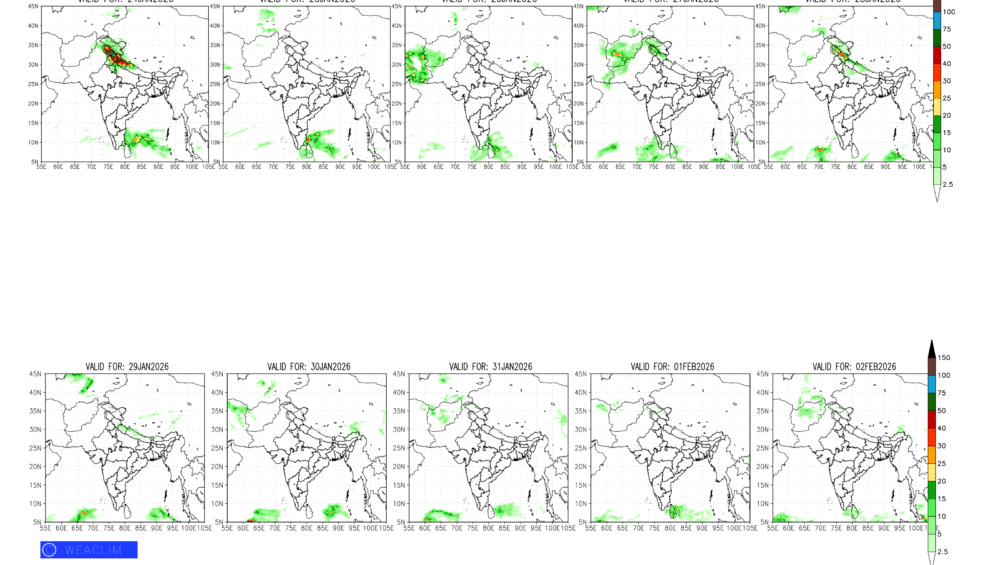
Winter 2026  Update Over Indian Subcontinent

| GFS Analysis | Initialized with #NCEP #GFS 30th January 2026 / 0000 UTC | Valid till 09th February 2026 / 0000 UTC | Inputs from #IMD, New Delhi |

⏱️ Synoptic Features:

🔺Two Western Disturbances (WD) move in succession across J&K and adjoining Western Himalayas during the period from 30th January to 04th February 2026. Third WD from 06th to 08th February 2026. These WDs interact with southwesterly winds in low and mid levels bringing in moisture from the Arabian Sea over the plains of West, Northwest and Central parts of India. Sub Tropical Westerly Jet (STWJ) shifts southwards to 22°N Latitude during the forecast period. Deep amplitude troughs in Upper Tropospheric Westerlies at 200 hPa move eastwards across North and Central India between 31st January to 04th February and again for shorter duration between 6th to 8th February 2026.

🔺Two troughs of Low Pressure move across South Indian Peninsula during 31st January to 07th February 2026.

🌧️ Rainfall Outlook:

🔺North India: Fairly-widespread Rain/Snow over the Western Himalayas in association passage of WDs with scattered heavy spells over J&K, Himachal Pradesh, Uttarakhand, Uttar Pradesh and adjoining northern plains upto Central parts of India between 31st January to 04th February 2026 and again between 06th to 08th February 2026.

🔺West, Central & Indo Gangetic Plains: Light shallow Fog/Smog and Mist activity over these regions mainly during morning hours of the forecast period with dense activity after the rains. 

🔺South Peninsula: Scattered light/moderate rainfall will occur over Tamil Nadu and adjoining regions between 31st January to 8th February 2026.

🌡️ Temperature Trends: Temperatures rise over the Plains of entire Indian Subcontinent during the forecast period. 

🔺 Minimum: 00-05°C over Punjab; 05-10°C Plains of North and Northwest India, 10-15°C over Plains of North, Northwest, West India, Indo Gangetic Plains and East India; 15-20°C Central India, 20-25°C reaching 30°C over Central & South India.

🔺 Maximum: 15-20°C over Plains of North and Northwest India. Rising to 20-25°C over Plains of North, Northwest, West India, Indo Gangetic Plains and East India; 25-30°C reaching 35°C over Central & South India.

CategoriesNews & Bulletin

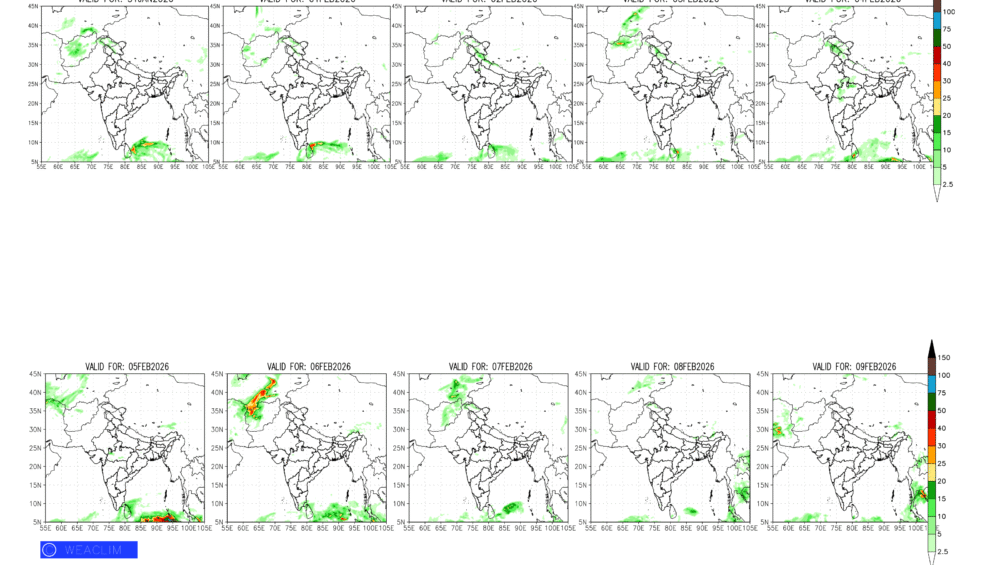
Winter 2026  Update Over Indian Subcontinent 

| GFS Analysis | Initialized with #NCEP #GFS 23rd January 2026 / 0000 UTC | Valid till 02nd February 2026 / 0000 UTC | Inputs from #IMD, New Delhi |

⏱️ Synoptic Features:

🔺Present Western Disturbance (WD) persists over J&K till 24th January. Fresh Active WD moves to J&K on 26th January to affect Western Himalayas and adjoining Nepal till 28th January.

🔺Trough of Low Pressures moves across South Indian Peninsula during 24th to 28th January 2026. Next one appears again over Andaman Sea on 28th and reaches Tamil Nadu by 31st January. 

🌧️ Rainfall Outlook:

🔺North India: Rain/Snow over the Western Himalayas in association with present WD will wane off today. Fairly-widespread Rain/Snowfall with isolated heavy spells will occur over J&K, Himachal Pradesh, Uttarakhand and adjoining northern plains between 26th to 28th January 2026.

🔺West, Central & Indo Gangetic Plains: Generally, cloud free skies will prevail over these regions with Dense Fog/Smog and Mist activity mainly during morning hours of the forecast period. 

🔺South Peninsula: Scattered light/moderate rainfall will occur over Tamil Nadu and adjoining regions between 24th to 28th January. Next spell occurs sequentially from South Andaman Islands on 28th January, across to South-central Bay of Bengal and then over South Tamil Nadu and adjoining Sri Lanka between  31st January to 02nd February 2026. 

🌡️ Temperature Trends: Sub zero temperatures persists over the Western Himalayas, whereas temperatures rise significantly over the Plains of entire Indian Subcontinent. 

🔺 Minimum: 00-05°C over Punjab till 25th January; 05-10°C Plains of North and Northwest till 26th January. Thereafter, 10-15°C over Plains of North, Northwest, West India, Indo Gangetic Plains and East India; 15-20°C Central India, 20-25°C over Central & South India.

🔺 Maximum: 15-20°C over Plains of North and Northwest India till 26th January. Thereafter, Max temperatures rise to 20-25°C over Plains of North, Northwest, West India, Indo Gangetic Plains and East India; 25-30°C over Central & South India.

CategoriesNews & Bulletin

Meteorological Products for Renewable Energy Sector is Now Available

WeaClim Solutions Pvt Ltd offers an expanded range of additional meteorological products tailored for the Renewable Energy sector, accessible via both its website and mobile app. These products include high-resolution wind and solar forecasts, enabling more accurate prediction of resource availability on hourly to sub-hourly scales. Solar irradiance mapsclearness index data, and global horizontal irradiance (GHI) metrics help optimize photovoltaic and concentrated solar power generation. For wind energy, users can access terrain-adjusted wind speed and direction forecastswind power density, and shear profiles crucial for turbine siting and yield estimation.

The platform also provides short-term and medium-range forecastshistorical climatology, and extreme weather alerts to support operational planning and risk mitigation. All products are presented in interactive dashboards, downloadable reports, and API feeds for seamless integration with energy management systems. The app offers real-time updates and push alerts, ensuring stakeholders stay informed and can make data-driven decisions to enhance efficiency and profitability in renewable projects.